
Why Great Leaders Stop Making Every Decision
The most dangerous leader in an organisation may be the one everyone trusts to make the right decision.
They are decisive. They are knowledgeable. They never leave a difficult problem unresolved. When a team is stuck, they step in. When two managers disagree, they settle it. When an important decision needs to be made, everyone knows exactly who to turn to.
That sounds like exceptional leadership, doesn't it?
But what happens when the leader becomes the answer to every question?
Slowly, something changes. Teams stop trusting their own judgement. Managers become hesitant to act without approval. Employees learn that the safest option is to escalate rather than decide. The organisation may appear well-led from the outside, while underneath, its ability to think and act independently is weakening.
So, who is actually the better leader: the person who makes the right decisions, or the person who develops people capable of making the right decisions themselves?
That question sits at the centre of distributed leadership. Because the ultimate measure of leadership may not be how much you can control, but how much capability you can create beyond yourself.

The Hidden Cost of Every Decision:
When you first lead a team, being involved in every important decision can feel responsible. You know the business and understand the risks.
But as the organisation grows, more and more issues reach your desk. Soon, you are no longer simply leading the organisation. You have become its decision-making centre.
That creates a bottleneck. Your calendar becomes crowded, teams become dependent, and opportunities can disappear while everyone waits.
If you recognise yourself in this story, the answer is not to care less. It is to lead differently.
Distributed Leadership Changes the Question:
Distributed leadership begins with a simple shift. Instead of asking, “How can I make sure every important decision comes to me?” you ask, “How can I create the conditions for the right people to make good decisions?”
You are not giving away responsibility. You are giving people clarity, information, boundaries, and the confidence to take ownership.
Think about a customer-facing team facing a problem that cannot wait three days for executive approval. If the team knows its priorities and decision-making boundaries, it can resolve the issue where it happens. That is agility in practice.
From Decision-Maker to Decision Enabler:
For many leaders, this is the hardest part. You may be comfortable making the decision but less comfortable watching someone else do it.
Suppose a manager asks, “What should I do?” Instead of giving the answer, ask, “What options have you considered, and which would you choose?”
When you help someone think through a decision, you build capability and teach judgement instead of creating dependence.
Over time, your team begins arriving with solutions instead of questions. Your attention becomes available for decisions that genuinely require your leadership.
It is not a loss of control. It is a better use of leadership.
Why Autonomous Systems Make This More Important
Now imagine adding autonomous systems to the organisation.
AI tools, intelligent workflows, and automation can handle many tasks that once required constant human intervention. As these systems become more autonomous, the old model of leadership becomes harder to sustain.
One leader cannot monitor every human decision, automated workflow, and emerging opportunity.
Your role becomes more important in setting direction, defining principles, establishing guardrails, and creating a culture where people exercise judgement responsibly. Autonomous systems can accelerate execution, but leadership still determines priorities and where human judgement remains central.
The organisation becomes stronger when decisions are distributed across capable people and supported by intelligent systems.
Trust Makes Distributed Leadership Work:
Distributed leadership cannot exist without trust, but trust does not mean removing accountability.
People need to know what they own, what success looks like, which risks they can accept, and when to escalate. They also need leaders who respond to mistakes with learning rather than blame.
Imagine an employee making a decision within clear boundaries and getting the outcome wrong. If your reaction is, “This is why I should have made the decision myself,” people learn to avoid ownership.
But if you ask, “What did we learn, and what would help you make this decision better next time?” you turn an imperfect outcome into organisational learning.
That is how accountability and empowerment coexist.
The Leader Who Creates More Leaders:
The real impact of distributed leadership becomes visible when people no longer look to one person for every answer. Instead of waiting for approval, teams begin using their judgement, taking ownership, and making decisions within the clarity and boundaries their leaders have created.
This does not mean leaders become less involved. It means their involvement becomes more purposeful. Rather than spending their time resolving decisions that others could make, leaders can focus on strategic priorities, complex challenges, and the decisions that genuinely require their experience and perspective.
As more people develop the confidence and capability to make sound decisions, leadership becomes less concentrated in one person. Managers grow into stronger leaders, employees become more accountable, and the organisation can respond to challenges without constantly waiting for direction from the top.
That is the real measure of great leadership: not how many decisions a leader makes, but how many capable decision-makers they help create.
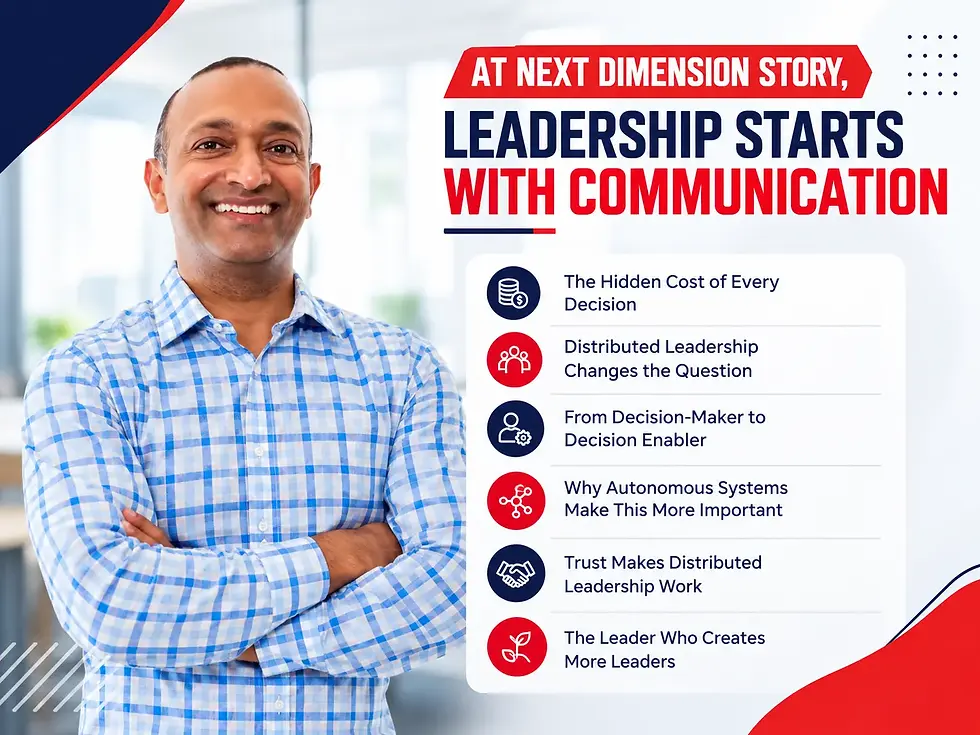
At Next Dimension Story, Leadership Starts With Communication:
Hi, I’m George Eapen. For over 20 years, I have had the privilege of coaching senior executives, business leaders, and professionals across different industries and backgrounds.
One lesson has remained constant: every leadership breakthrough begins with communication.
That philosophy is at the heart of Next Dimension Story. No two leadership journeys are the same, which is why we offer different ways for you to keep growing. You can begin with our free Leadership Reflection Worksheet, explore complimentary webinars on Executive Leadership, Smart Decision-Making, and 10X Business Branding, or go deeper with The Art of Storytelling.
These resources help you move beyond delivering messages, develop emotional intelligence, create authentic connections, and build lasting trust.
Before We Finish, Ask Yourself One Question:
If every important decision in your organisation still needs to reach your desk, are you building a scalable organisation, or are you quietly training everyone to wait for you?
The next stage of leadership may not require more decisions from you. It may require more decision-makers.
Your next conversation, delegation, and difficult decision can reinforce dependence or build capability. Communicate with intent and create the clarity and trust people need to act.
If you are ready to strengthen how you communicate, lead, and empower others, let’s work on it together through a personalised one-to-one Executive Leadership Coaching session with Next Dimension Story.
Frequently Asked Questions
Does distributed leadership mean leaders should stop making decisions?
Not at all. Distributed leadership does not mean stepping away from leadership; it means becoming more intentional about which decisions you make and which decisions you enable others to make. Your role shifts from being the person who decides everything to being the person who creates the clarity, direction, and boundaries that help others make sound decisions.
How do I know which decisions I should delegate?
Start by asking yourself whether a decision genuinely requires your experience, authority, or strategic judgement. If someone closer to the work has the information and capability to make the decision, giving them ownership can often lead to a faster and better outcome. Your most valuable decisions are usually the ones that require your broader perspective, not your constant involvement in everyday operations.
What happens if employees make the wrong decisions?
Mistakes are inevitable, whether decisions are made by you or by your team. The goal is not to eliminate every mistake but to create an environment where people learn from them. When employees understand their decision-making boundaries and know that thoughtful mistakes will be treated as learning opportunities, they become more confident and accountable.
Can distributed leadership work with AI and autonomous systems?
Yes, and it may become increasingly important as autonomous systems take on more tasks and decisions. AI can accelerate processes and provide information, but people still need to establish priorities, ethical boundaries, accountability, and strategic direction. Distributed leadership helps organisations combine human judgement with increasingly autonomous technology without making one leader the approval point for everything.


Comments