
Your Culture Is Being Created in Conversations You’re Not Listening To
Your organisation has two cultures.
The one you say you have.
And the one your people experience every day.
One lives in the values statement.
The other lives in conversations.
In meetings.
In emails.
In feedback.
In the way a manager responds when someone makes a mistake.
In whether disagreement is welcomed or punished.
And in what happens when someone says:
“I don't think this is working.”
That moment tells employees more about your culture than almost anything written on an office wall.
Because understanding leadership dynamics in corporate culture starts with one simple truth:
Culture isn't something organisations announce. Culture is something people experience.
And leadership shapes that experience every day.
THE 10-SECOND CULTURE TEST
Imagine this.
A junior employee spots a serious problem with an important project.
The leadership team is committed to it.
Deadlines have been announced.
Money has been spent.
Senior people have publicly supported the decision.
Then the employee says:
“I think we're making a mistake.”
What happens in the next 10 seconds?
Does someone become curious?
Do they ask the employee to explain?
Or...
Does the room go quiet?
Does a manager become defensive?
Does somebody subtly shut the conversation down?
Those ten seconds just taught everyone something.
Not about the project.
About the culture.
This is organisational culture and leadership in action.
Not theory.
Not values on a website.
Behaviour.
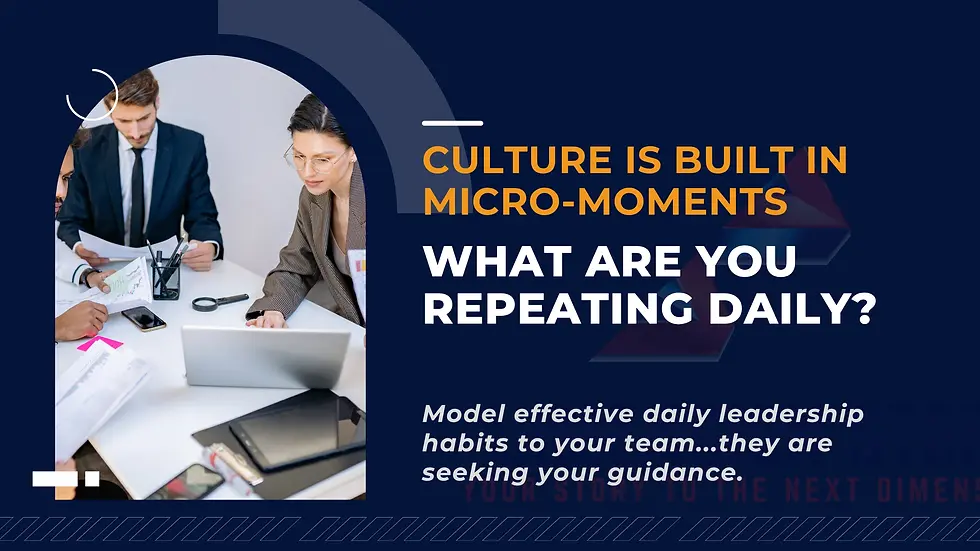
CULTURE IS BUILT IN MICRO-MOMENTS
Leaders often think about leadership and company culture at the macro level.
Purpose.
Values.
Engagement programmes.
Town halls.
Transformation initiatives.
These matter.
But employees experience leadership and workplace culture at the micro level.
When someone makes a mistake, are they coached or blamed?
When someone challenges an idea, are they heard or labelled difficult?
When pressure rises, do leaders listen or control?
When leaders don't know the answer, do they admit it?
These moments appear small.
Repeated hundreds of times, however, they become:
“How things are done around here.”
That is why organisational culture leadership cannot be separated from everyday managerial behaviour.
If you want to understand how executive leadership shapes team culture, don't start with the mission statement.
Watch what leaders repeatedly do.
Executives, managers, business owners, who go through the Next Dimension Story Leadership Effectiveness Coaching tools understand this truth very well – what leaders repeat on a daily basis becomes the cultural norm within the organisation…no matter how big or small the organisation.
This is human-centred leadership that Next Dimension Story focuses on…to help leaders to shape team culture and organisation culture effectively whilst equipping team members to embody the cultural cues effectively.
Take an hour to coach yourself on cultural techniques…from setting goals to daily cultural techniques to conflict resolution to shepherding the team through choppy waters…Sign up to the Effective Leadership Video Course or Audio Course today….and intentionally set the organisation culture through daily habits.
EVERY CONVERSATION LEAVES A TRACE
Some conversations build trust.
Others quietly destroy it.
Some create ownership.
Others create fear.
Consider the difference between:
“Who caused this?”
and:
“What can we learn from this?”
Or:
“Just do what I've asked.”
and:
“What do you think?”
Small changes in language.
Huge differences in culture.
This is why leadership communication and effective interpersonal communication are not simply soft skills.
They are culture-building mechanisms.
Communication in organisational culture signals what is safe, what is rewarded and what happens when things go wrong.
And internal communication and workplace culture are inseparable.
What leaders repeatedly say, and how they say it, eventually becomes part of the organisation's unwritten leadership operating system.
What you say as a leader and how you say it will become part of the organisation’s operating system language….Leaders who fully internalise this and take action to step up their communication effectiveness will reap significant dividends for their team and for their leadership impact across the organisation.
Next Dimension Story’s Communication Effectiveness Video and Audio courses equips you with the necessary communication tools to set company culture and business culture through your words and how you say them…on a daily basis. Take the opportunity today to strengthen your communication skill set and see the benefit within weeks as you set organisational culture to boost team effectiveness and productivity.
THE LEADER'S SHADOW
People watch leaders more closely than leaders realise.
A leader says:
“I want people to challenge me.”
But becomes defensive when challenged.
The behaviour wins.
They say:
“We trust our people.”
But require approval for every meaningful decision.
The behaviour wins.
They say:
“Wellbeing matters.”
But celebrate people working until midnight.
Again...
The behaviour wins.
This is leadership behaviour and culture at its most powerful.
Employees don't learn culture from what leaders claim matters.
They learn it from what leaders repeatedly demonstrate matters.
That's how leadership shapes organizational culture.
And it explains how managerial actions shape team culture far more powerfully than any corporate slogan.
EMOTION BECOMES CULTURE TOO
Culture isn't shaped only by what leaders do.
It's shaped by how people feel around them.
Can I disagree?
Can I admit I don't know?
Can I make a mistake?
Can I tell the truth?
This is where emotional intelligence leadership, human-Centered leadership and leadership empathy at work become practical organisational capabilities.
A leader who listens before judging creates safety.
A leader who remains curious during disagreement creates openness.
A leader who responds calmly under pressure creates stability.
That strengthens employee belonging and leadership, while creating a deeper emotional connection in teams.

Especially when practising strategic leadership under pressure, your emotional response becomes part of your culture. At Next Dimension Story, we coach leaders to keep calm and walk out strategic leadership under pressure…and then to model this as part of the workplace culture…sometimes pressure is a strong canvas to model strategic leadership behaviours and habits.
Take the initiative today to master emotional intelligence and conflict resolution techniques to model the necessary leadership behaviour during times of pressure and set the template for the rest of your team to follow you.
STORIES TELL PEOPLE WHAT MATTERS
There is another powerful cultural tool leaders often underestimate:
Storytelling.
Policies explain what should happen.
Stories show people what the organisation actually values.
The story of the employee who challenged a bad decision.
The manager who admitted a mistake.
The team that put the customer ahead of hierarchy.
These stories travel.
This is the power of storytelling in leadership.
Effective leadership storytelling turns abstract values into memorable human behaviour.
It's why storytelling and leadership are so closely connected, and why storytelling for leadership can strengthen both executive presence and culture.
If you've ever wondered, “Why is storytelling important in leadership?”, this is one reason:
People may forget the value statement. They remember the story that proves it.
Used authentically, leadership through storytelling can reinforce expectations, improve executive presence and storytelling, and help teams understand what good leadership looks like.
Next Dimension Story’s Communication Effectiveness Video and Audio courses equips you with the storytelling skills you need to model leadership culture through powerful storytelling. Take the opportunity today to strengthen your communication skill set and see the benefit within weeks as you set organisational culture to boost team effectiveness and productivity.
THE CULTURE MULTIPLIER
Want stronger leadership and organisational culture?
Start with four behaviours.
1. CURIOSITY BEFORE JUDGEMENT
Replace:
“Why did you do that?”
with:
“Talk me through what happened.”
One creates defence.
The other creates dialogue.
2. CLARITY BEFORE CONTROL
Set expectations and boundaries, then give people room to think.
That's leadership without micromanagement.

3. FEEDBACK BEFORE FRUSTRATION
Healthy cultures don't avoid difficult conversations.
They develop the leadership skills for difficult conversations required to have them well.
4. CONSISTENCY UNDER PRESSURE
Values matter most when following them becomes inconvenient.
Pressure doesn't create culture.
It reveals it.
ONE CONVERSATION
Before your next conversation, ask:
“What culture will my response create?”
More trust?
More fear?
More ownership?
More dependency?
More openness?
More silence?
Because leadership and culture aren't separate.
Neither are leadership and corporate culture.
Every conversation, decision, story and reaction sends a signal about what your organisation really values.
That's leadership in organizational culture.
Not once a year.
Not at the company conference.
Not when the values are rewritten.
Conversation by conversation.
Your culture isn't hanging on the wall.
It's happening in the room.
And your next interaction...
is already shaping it.


Comments