
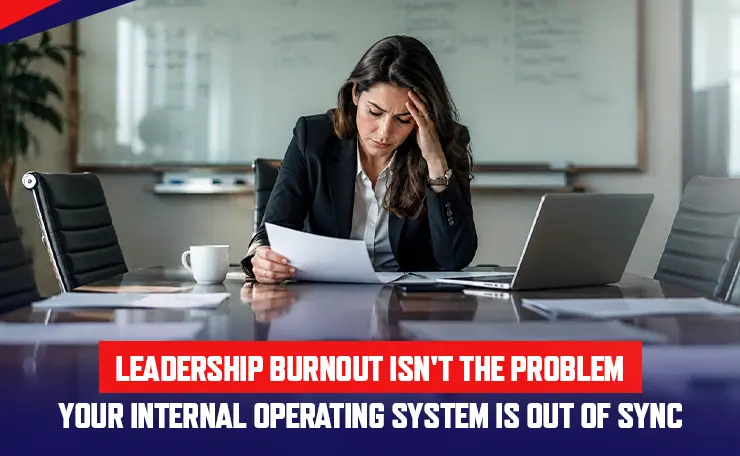
Leadership Burnout Isn't the Problem: Your Internal Operating System Is Out of Sync
"George, I don't think I'm burned out. I'm just... tired in a way I can't explain."
Those words have stayed with me for a long time.
They came from a senior business leader who had every reason to feel proud of what he had achieved. His organisation was growing, his team respected him, and his family believed he had finally reached the stage of life where everything should have felt rewarding. Yet as we sat across the table from each other, it became evident that what he was experiencing wasn't the exhaustion that follows a demanding week. It was something deeper. An emotional fatigue that no weekend getaway or productivity app could resolve.
Perhaps you have experienced something similar.
You finish an important meeting, but your mind continues replaying every conversation long after everyone else has moved on. You make difficult decisions, yet instead of feeling relieved, you begin questioning whether you could have handled them differently. You carry the expectations of your organisation with confidence, while quietly wondering who carries yours.
If that resonates with you, let me reassure you of one thing. What you are experiencing may not be burnout at all.
It may simply be your internal operating system asking for an update.
In today's leadership conversations, we often focus on visible symptoms like long working hours, endless meetings, growing workloads, and work-life balance. These certainly matter. However, in my experience of working with leaders across industries, they are rarely the real problem. More often than not, burnout is the final chapter of a story that began much earlier, within the invisible mental and emotional patterns that quietly shape how we think, decide, communicate, and lead.
The Story You Carry Is the Leader You Become:
Allow me to ask you a question.
Have you ever noticed how two leaders can face the same crisis and respond in completely different ways?
One remains calm, gathers the facts, communicates with clarity, and inspires confidence. The other loses sleep, second-guesses every decision, and carries the emotional burden of every possible outcome.
The difference is rarely intelligence or experience. The difference lies in the story each leader has been telling themselves for years.
Your internal operating system is nothing more than that invisible collection of beliefs, assumptions, emotional habits, and thought patterns that influence every decision you make. It determines how you interpret uncertainty, how you respond to failure, how you communicate under pressure, and how much emotional energy leadership demands from you every single day.
Just as outdated software struggles to keep pace with new technology, an outdated internal operating system struggles to support the demands of modern leadership.
Q&A Reflection
Q. If I am still performing well, why should I worry about my internal operating system?
Because performance can hide emotional strain remarkably well. Many high-performing leaders continue delivering exceptional results while quietly carrying increasing levels of mental fatigue. By the time burnout becomes visible, the underlying patterns have often been shaping their leadership for years.
Leadership Is Emotional Before It Is Strategic
One of the greatest misconceptions about leadership is that success depends primarily on strategy.
Strategy is important. Communication is important. Decision-making is important. But before any of these comes something even more fundamental, that is, your emotional relationship with leadership itself.
Every day, you absorb uncertainty so that your team can feel secure. You make decisions knowing that someone will disagree with them. You navigate conflict while maintaining professionalism. You encourage others even when you are wrestling with your own doubts.
None of these responsibilities appear in a job description, yet they consume an extraordinary amount of emotional energy. This is why leadership cannot be separated from mental wellness. Nor can it be separated from communication. The conversations you have with others are always influenced by the conversations you are having with yourself.
What Exceptional Leaders Understand That Others Often Miss:
Leadership excellence is rarely defined by external circumstances and is shaped by the internal mindset with which those circumstances are approached. Consider Paul Polman, whose leadership demonstrated that long-term organisational success could coexist with purpose, empathy, and sustainable decision-making. Rather than focusing solely on quarterly performance, he encouraged leaders to think beyond immediate results and cultivate cultures built on trust and resilience. Closer to home, James Timpson has become widely recognised for leading with humanity, empowering employees through trust and second chances rather than fear and control. Although they operate in very different contexts, both leaders illustrate the same enduring truth: exceptional leadership is not simply about managing complexity. It is about developing the emotional and psychological capacity to respond to complexity with clarity, composure, and conviction.
This realisation became the foundation on which I built Next Dimension Story.
Whether I am working with someone through my one-to-one executive coaching sessions, delivering leadership programmes for organisations, or guiding learners through my Executive Leadership and Business Storytelling video courses, the objective remains the same: helping people transform the stories that shape their leadership.
Because techniques may improve performance. Transformation changes lives.
Q&A Reflection
Q. Can changing my mindset really make me a better leader?
Absolutely. Leadership is not simply a collection of skills. It is an expression of how you think. When your internal beliefs become healthier, your communication becomes clearer, your decisions become more confident, and your leadership becomes more sustainable.

Growth Begins With Reflection, Not Reinvention:
One of the questions I am frequently asked is, "George, where should I begin?"
My answer is always simple.
Begin by understanding yourself before attempting to change yourself.
That is precisely why, at Next Dimension Story, I have created learning pathways for leaders at every stage of their journey. Some people begin with my free one-page worksheet, using it as a simple exercise to reflect on their leadership habits. Others join one of my complimentary webinars on Executive Leadership, Smart Decision-Making, Interview Success, or 10X Business Branding to explore these ideas in greater depth.
For those who are ready to invest in deeper transformation, my Executive Leadership Video Course, Business Branding and Storytelling programmes, career transition resources, audiobook, and personalised one-to-one coaching provide practical frameworks that help leaders strengthen not only what they do but also who they become.
Every programme has been created with one belief in mind: lasting success begins by changing the story within.
Before You Call It Burnout…
As you finish reading this article, I invite you to pause before describing your current experience as burnout.
Ask yourself a different question instead.
What story has been quietly running through my leadership for all these years?
Perhaps it is the belief that you must always have the answers.
Perhaps it is the assumption that asking for help is a sign of weakness.
Or perhaps you have convinced yourself that your value as a leader depends entirely on your performance.
Whatever that story may be, remember this: you have the ability to rewrite it.
Leadership is not about carrying every burden alone. It is about developing the emotional resilience to carry responsibility without allowing responsibility to carry you.
That is the journey I hope to continue with you throughout this series.
Because in our next article, we will explore another invisible challenge that silently shapes every leader's effectiveness—why decision fatigue has less to do with the number of decisions you make and far more to do with the emotional weight you attach to each one.
Until then, remember this:
The most powerful transformation in leadership never begins with changing your calendar. It begins with changing the story that is running your life.
Frequently Asked Questions:
What is a leader's internal operating system?
It is the collection of beliefs, emotional habits, mental models, and behavioural patterns that influence how you respond to pressure, uncertainty, communication, and decision-making.
Is burnout always caused by excessive workload?
No. While workload contributes, burnout is often the result of prolonged emotional strain and deeply ingrained internal patterns that remain unaddressed.
How can I strengthen my emotional resilience as a leader?
Start by increasing your self-awareness, reflecting on your leadership beliefs, developing healthier communication habits, and investing in continuous learning through coaching or leadership development programmes.
How can Next Dimension Story help me become a better leader?
At Next Dimension Story, I offer free learning resources, webinars, executive leadership programmes, video courses, business storytelling training, career development resources, audiobooks, and personalised one-to-one coaching designed to help leaders communicate with greater confidence, make smarter decisions, and lead with lasting impact.
Why is self-awareness so important in leadership?
Because every leadership decision begins with a thought. When you understand the stories shaping your thinking, you become better equipped to lead others with clarity, confidence, and purpose.



Comments