
When Strength Becomes Noise: The Hidden Cost of Overusing Leadership Traits
I want to tell you about a leader I worked with, who was sharp, fast-thinking, and deeply committed to his team. When a problem lands, these kinds of people are already three steps into solving it before most people have finished reading the message. Their team respects them. Their results are real.
And slowly, almost invisibly, their team has stopped thinking for themselves.
Nobody planned this. Nobody wanted it. It happened because this leader's greatest strengths, speed, decisiveness, and ownership, never had a dial. They were always turned up to ten.

The thing nobody tells high performers?
Here is what nobody really says when you are coming up as a high performer: the traits that got you here will eventually work against you if you do not learn to modulate them. Not replace them. Not suppress them. Just modulate.
The problem is, when you have been rewarded your whole career for moving fast and taking charge, slowing down feels like failure. Stepping back feels like disengagement. So you keep doing what worked, even when the context has changed and those same moves are now creating friction instead of momentum.
The instincts that earned your reputation can quietly become the thing your team builds their workarounds around.
So what does "too much" actually look like?
Decisiveness is a gift, until you start answering questions before your team has fully thought them through. They stop deliberating because the answer is coming anyway.
Ownership feels responsible. But when you pick up every loose thread, your team learns that you will catch whatever they drop. So they drop more and own less.
Responding to everything instantly tells your team that everything is urgent. Deep work disappears. Everyone follows your rhythm, even when that rhythm is unsustainable.
High standards are non-negotiable. But when "done right" always looks like how you would do it, people stop bringing rough ideas because rough ideas get corrected, not built on.
A quick check: in your last five team conversations, how many ideas came from someone other than you? If you are struggling to remember, that is your answer.
The frustrating part? You will not feel it happening.
Your team will not tell you. Not directly. What they will do is get quieter in meetings. More careful in how they word things. They will wait for your take before sharing theirs. They will loop you in on decisions that really should not need you.
And because the work is still getting done, you have no obvious signal that anything has shifted. The damage is in what is not happening: the ideas nobody pitched, the calls nobody made, the initiative that quietly dried up.
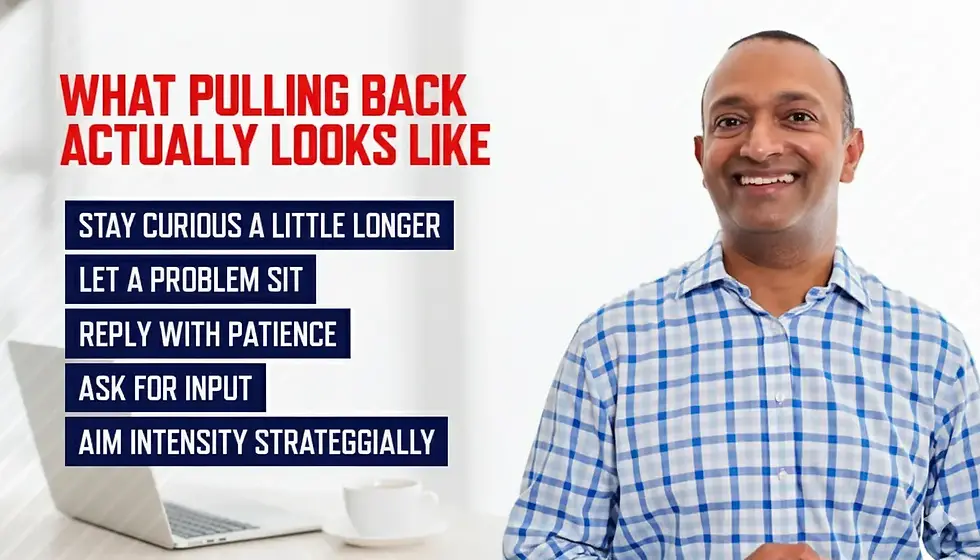
What pulling back actually looks like
This is not about becoming less decisive or caring less. It is about being deliberate when you show up fully and when you hold back on purpose.
Stay curious a little longer before you become conclusive. Let a problem sit in the room for a few minutes before you solve it. Reply to that message in two hours instead of two minutes. Ask, "What do you think we should do?" and actually wait for an answer, a real one, not a prompt for yours.
Remember that it will feel uncomfortable, but that discomfort is the work. The leaders who figure this out are not the ones who stopped being intense. They are the ones who learned to aim their intensity at the moments that genuinely need it, and nowhere else. That is not a smaller version of leadership. That is the advanced version.
Let’s Find Out More About George Eapen and Next Dimension Story
My name is George Eapen. Over the past 19 years, I have clarified, defined, and communicated successful stories for organizations like Procter and Gamble, PepsiCo, and Vodafone, as well as for global tech companies, small businesses, and individual leaders across the world.
That shift, from performing leadership to practicing it, is exactly what we focus on at Next Dimension Story. Our Executive Leadership Video Course was built for moments like the ones described in this article. It helps you identify the decision-making patterns underneath your actions, the ones running quietly in the background, and gives you concrete tools to use when the pressure is real and clarity feels out of reach.
From there, the Make Smart Decisions program takes you deeper. Every leader has a default decision style, and this program helps you see yours clearly, understand the signals it sends to your team, and build the awareness to shift when the situation calls for it. Our short audio lessons and guided micro-habit tools make this practical rather than theoretical, so you are not just learning in a classroom moment but carrying the awareness into your actual week.
And once you are making decisions with greater intention, the art and science of storytelling help you land them well. Because a good decision communicated poorly still creates confusion.
Frequently Asked Questions:
How do I know if I am overusing a leadership strength rather than just being effective?
The clearest signal is in what your team stops doing. If people wait for your direction before acting, rarely push back, or consistently defer their ideas, that is not a sign they trust you. It is a sign your presence has started to crowd out their initiative.
Will pulling back make me look less committed or engaged as a leader?
Pulling back strategically is not the same as disappearing. When you choose not to answer first or solve immediately, you are making an intentional leadership decision. Your team will feel the difference between a leader who is disengaged and one who is deliberately creating space for others to grow.
Is this something that can be trained, or does it only come with experience?
Both, but experience alone rarely teaches it because the feedback loop is too slow and too indirect. That is exactly why the Make Smart Decisions program focuses not just on awareness but on micro-habits, small, repeatable practices you can apply in the middle of a busy week, not just in a retreat or workshop setting.
Ready to lead with more intention?
If any part of this resonated with you, the good news is that awareness is already the first step. The next one is building the practical habits to match it. Whether you are looking to sharpen your decision-making, understand the signals you are sending your team, or communicate your leadership with greater clarity and confidence, Next Dimension Story has a program built for exactly where you are right now.
Visit our website to explore more or book a direct 1-to-1 coaching session with me, George Eapen, and start building the kind of leadership your team can genuinely grow around.


Comments