
The Leadership Energy Crisis: Why Burnout Is Quietly Weakening Decision-Making
It was a year back, Sarah had spent nearly fifteen years building a reputation as a decisive leader. As the Managing Director of a successful consulting firm, she was known for navigating uncertainty with confidence and making difficult decisions without hesitation. Her team trusted her judgment, clients respected her insight, and colleagues often sought her advice during challenging situations.
Yet one ordinary Thursday afternoon, something felt different.
She sat alone in her office reviewing a proposal that should have taken no more than ten minutes to approve. The numbers were clear. The risks were manageable. The opportunity aligned with the company's strategy. Despite this, she found herself reading the same page repeatedly, unable to reach a conclusion.
At first, she assumed she needed more information. Then she wondered whether she had overlooked an important detail. Eventually, she realised the truth was much simpler.
She was completely exhausted.
Not physically exhausted in the traditional sense. She was mentally drained from months of constant decision-making, back-to-back meetings, endless emails, and the pressure of being available to everyone at all times.
For the first time in her career, Sarah began to question whether the greatest threat to her leadership was not a lack of knowledge, but a lack of energy.

When Constant Availability Became a Leadership Badge of Honour
Like many ambitious professionals, Sarah had gradually adopted a leadership style that rewarded availability above all else. She responded to messages late at night, accepted every meeting request, and rarely took uninterrupted time to think. The behaviour felt responsible, and people around her often praised her dedication.
What she did not recognise was how much this constant accessibility was costing her.
The more she filled her schedule, the less space she had for strategic thinking. She noticed that creative ideas no longer came as easily as they once had. Complex discussions felt more draining than stimulating. Conversations that previously required patience now triggered frustration.
From the outside, she looked productive.
On the inside, she was operating with diminishing mental reserves.
Many organisations unknowingly celebrate this behaviour. Leaders who work longer hours are often viewed as more committed, while those who create space for reflection can appear less engaged. Yet leadership has never been measured by how busy someone is. It has always been measured by the quality of the decisions they make.
The Decision That Exposed a Hidden Problem
Several weeks later, Sarah attended a quarterly strategy meeting with her leadership team. They presented two potential expansion opportunities, each supported by strong data and compelling business cases.
Normally, Sarah would have guided the discussion with clarity and confidence. Instead, she hesitated. The meeting stretched on far longer than expected. Questions remained unanswered. The team left without a clear direction.
Afterwards, one of her senior managers approached her privately.
"You seem different lately," he said. "You're still working as hard as ever, but it feels like you're carrying a weight that wasn't there before."
His observation stayed with her for days.
Sarah realised that her fatigue was no longer affecting only her. It was influencing her team's confidence, communication, and momentum. The energy she brought into the room was shaping the culture around her, whether she intended it or not.
The Wake-Up Call That Changed a Global Leader's Perspective
Sarah's experience may sound familiar, but she is not alone. Even some of the world's most successful leaders have discovered the consequences of operating without adequate recovery.
In 2007, Arianna Huffington was running a rapidly growing media business while juggling an intense workload. The pressure eventually caught up with her. Exhausted and sleep-deprived, she collapsed from burnout, hitting her head and suffering a fractured cheekbone. What followed was a profound reassessment of how she viewed success and leadership.
Rather than treating exhaustion as a badge of honour, Huffington began advocating for sustainable performance, arguing that leaders make better decisions, communicate more effectively, and create healthier organisations when they prioritise energy and wellbeing alongside results.
Her experience highlights an important truth that many executives still overlook. Leadership effectiveness is not determined solely by intelligence, ambition, or experience. It is also shaped by the quality of a leader's physical and mental energy. When those reserves become depleted, even highly capable individuals can struggle to perform at their best.
For Sarah, this story felt uncomfortably familiar. She had not reached a breaking point, but she could see the warning signs. The question was whether she would address them before they began affecting the organisation she had worked so hard to build.
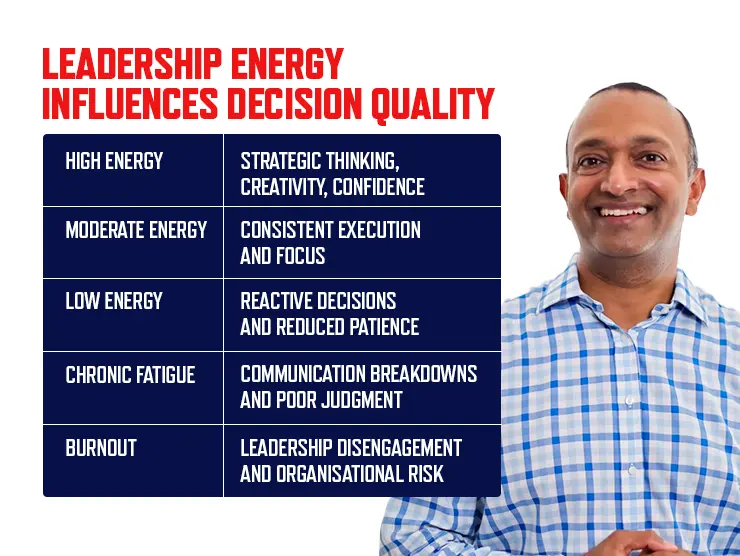
How Leadership Energy Influences Decision Quality
After learning how leadership energy influences decision quality, Sarah recognised herself immediately. She had been operating in the lower half for months while convincing herself everything was under control.
The Insight That Changed How She Viewed Leadership
Determined to understand what was happening, Sarah attended a leadership development course where she heard about decision-making and self-awareness. Hello, this is George Eapen and my perspective and training stands apart from the usual leadership advice focused on productivity and performance.
Why is that the case with my coaching programs from Next Dimension Story? With Next Dimension Story, you get a two pronged approach to sustainable leadership energy - self awareness skills through the power of executive wellbeing and storytelling combined with effective decision-making frameworks to equip you to make appropriate decisions whilst delegating decision making authority across your teams with effective guardrails. Over the past 19 years, I have helped organisations, including Procter & Gamble, PepsiCo, Vodafone, and leaders around the world clarify, define, and communicate their leadership energy to move teams ahead. What resonated most with leaders who went through the training was the practical approach behind the Executive Leadership Video Course, which helps leaders uncover the decision-making patterns influencing their actions beneath the surface. Leaders then continue their development through the Make Smart Decisions program, where short audio lessons and guided micro-habit tools help leaders recognise their default decision style and apply greater awareness during real leadership situations.
Like Sarah, do you want to discover effective leadership? Sign up to the courses mentioned above or book a 1 to 1 leadership session by clicking the following link - 1 to 1 Coaching with George Eapen
Why Sustainable Leadership Is Becoming a Competitive Advantage
Over the following months, Sarah made several changes. She protected time for strategic thinking, reduced unnecessary decision-making, and established clearer boundaries around her availability. More importantly, she stopped viewing exhaustion as evidence of commitment.
She discovered that sustainable leadership was not about working less. It was about managing energy more intelligently.
In an era where complexity continues to grow, leaders cannot afford to treat well-being as a personal concern separate from business performance. Mental clarity, focus, and resilience have become strategic assets that directly influence outcomes.
The Future Belongs to Leaders Who Protect Their Energy
Sarah's story reflects a challenge facing countless executives today. Many leaders continue chasing performance while overlooking the very resource that makes performance possible. Burnout rarely arrives overnight. It develops quietly through accumulated pressure, constant availability, and the belief that leadership requires endless endurance.
The strongest leaders understand something different. They recognise that their ability to think clearly, communicate effectively, and inspire confidence depends on how well they manage their energy.
Leadership is not an endurance competition.
It is a responsibility that demands clarity, presence, and intention. The leaders who learn to protect those qualities will not only make better decisions, but they will also build stronger teams, healthier cultures, and more sustainable success. Upgrade yourself with Next Dimension Story today!
FAQs
How does burnout affect leadership decision-making?
Burnout reduces mental clarity, focus, creativity, and emotional regulation, making it harder for leaders to make thoughtful and effective decisions.
Why is energy management important for leaders?
Energy management helps leaders maintain focus, improve communication, strengthen judgment, and perform consistently under pressure.
How can leaders prevent decision fatigue?
Leaders can reduce decision fatigue by prioritising recovery, creating time for strategic thinking, limiting unnecessary decisions, and developing greater self-awareness around their decision-making patterns.


Comments