
The Emotional Root of Execution Failure
Why great strategies fail long before execution begins.
Every year, organisations invest millions in developing strategy.
Leadership teams spend weeks refining plans.
Consultants produce detailed roadmaps.
Objectives are agreed.
Budgets are approved.
Timelines are set.
The strategy looks flawless.
Then six months later...
Projects have stalled.
Deadlines have slipped.
Teams have lost momentum.
Leaders begin asking the same questions.
"Was the strategy wrong?"
"Did we choose the wrong people?"
"Why can't we execute?"
In many cases, they're asking the wrong question.
Because execution rarely fails because of poor planning.
Execution fails because of unresolved emotion.
Fear.
Uncertainty.
Resistance.
A lack of trust.
These are the invisible barriers that quietly derail even the most brilliant strategies.
The organisations that consistently outperform others understand one fundamental truth.
Execution is never just operational.
It's deeply emotional.
The Leadership Assumption That Holds Organisations Back
Many organisations believe execution is simply about discipline.
Build a better plan.
Introduce another project tracker.
Increase accountability.
Hold more meetings.
Measure more KPIs.
Those actions may improve visibility.
They rarely address the real problem.
People don't resist strategies.
They resist uncertainty.
Every organisational change creates emotional questions.
"Will I still succeed?"
"Will I lose influence?"
"Will this increase my workload?"
"What happens if I fail?"
These conversations are happening quietly inside people's minds long before they happen in meeting rooms.
Leaders often focus on processes.
Employees experience change emotionally.
That's where execution begins to break down.
Next Dimension Story’s highly effective Executive Leadership Impact Framework equips leaders to gauge the emotional barometer of their employees and address these emotive drivers early on during strategy development. This will create the right environment that fosters a higher chance of success for the strategy/initiative. Give our Executive Leadership Video Course a try today and learn the core skillsets you need to increase the chance of success with your strategies.

Leadership Under Pressure Changes Everything
The greatest test of leadership under pressure isn't creating a strategy.
It's helping people believe in it.
During periods of uncertainty, employees don't simply watch what leaders do.
They watch how leaders behave.
They observe confidence.
They notice emotional reactions.
They listen carefully to every message.
Because leadership sets the tone for the entire organisation.
Calm leaders create calmer teams.
Anxious leaders create anxious organisations.
Confident leaders create confident execution.
This is the true leadership effect.
Whether positive or negative, every leader influences performance long before work begins.
Strategy Doesn't Create Culture. Leaders Do.
Many executives speak about culture as though it's a separate initiative.
It isn't.
Culture is the daily result of leadership behaviour.
This is how leadership shapes organizational culture.
Every conversation...
Every meeting...
Every decision...
Every reaction...
Gradually builds leadership organizational culture.
If leaders encourage curiosity...
Innovation grows.
If leaders punish mistakes...
Fear grows.
If leaders communicate openly...
Trust grows.
This is the direct relationship between leadership and workplace culture.
The same principle applies to leadership organisational culture, regardless of industry or organisation size.
Culture doesn't emerge accidentally.
It reflects what leaders consistently model.
Modelling a healthy work culture largely depends on the openness and vulnerability of the leader’s communication style. Master the art and science of storytelling communication today from Next Dimension Story and let your leadership foster trust and stable growth within your company.
Fear Is the Invisible Competitor
Fear rarely introduces itself honestly.
Instead, it sounds like...
"Let's wait another month."
"We need more data."
"Maybe we should revisit this next quarter."
On the surface these sound logical.
Underneath, they're often emotional.
Fear delays action.
Fear encourages silence.
Fear reduces innovation.
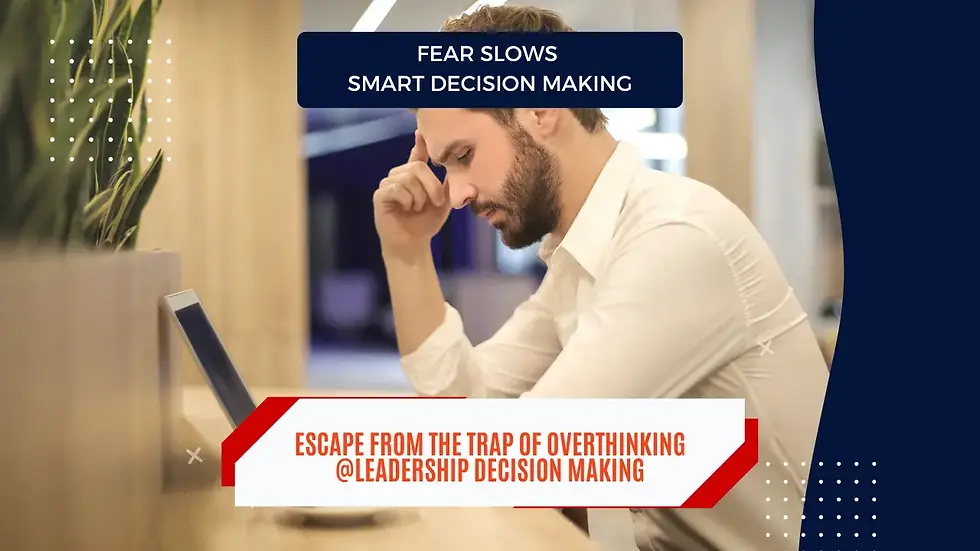
Fear slows smart decision making.
Before long, leaders find themselves trapped in overthinking in leadership.
Meetings become longer.
Decisions become slower.
Confidence begins to disappear.
The issue isn't intelligence.
It's emotion.
Leadership Communication Determines Execution
One of the biggest mistakes leaders make is assuming people need more information.
Most people don't.
They need more certainty.
Great leadership communication isn't simply about explaining strategy.
It's about reducing fear.
Providing clarity.
Creating confidence.
This requires outstanding communication and interpersonal skills and consistently effective interpersonal communication.
Employees don't follow PowerPoint presentations.
They follow leaders they trust.
That's why communication becomes one of the strongest predictors of execution success.
The Power of Storytelling in Leadership
Facts explain.
Stories persuade.
Statistics inform.
Stories inspire.
The power of storytelling in leadership lies in its ability to reduce uncertainty.
Stories help people see themselves in the future you're asking them to create.
This is why leadership storytelling has become one of the defining characteristics of exceptional executives.
The relationship between storytelling and leadership has existed for centuries.
Great leaders don't simply announce change.
They tell stories that make change meaningful.
Whether leading transformation, navigating crisis or introducing innovation, storytelling in leadership creates emotional connection long before execution begins.
Stories answer questions spreadsheets never can.
Why this matters.
Why now.
Why us.
That emotional connection reduces resistance.
It builds commitment.
It creates momentum.
The benefits extend beyond communication.
Research increasingly shows the value of storytelling and mental resilience.
Stories help people process uncertainty, create hope and maintain perspective during difficult periods.
Likewise, storytelling for emotional well-being enables leaders to normalise challenge while reinforcing optimism and purpose.
The most effective leaders don't simply communicate information.
They communicate belief.
Learn to communicate belief and normalise challenges by reinforcing optimism and purpose via the Next Dimension Story’s Effective Leadership Video Course and Audio Course. These valuable courses will enable you to become an effective leader who can communicate trust and growth across their teams.

Emotional Intelligence Is an Execution Strategy
For years, emotional intelligence was described as a soft skill.
Today, it's a competitive advantage.
Leaders with high emotional intelligence recognise emotional resistance before it becomes operational failure.
They notice changes in behaviour.
They recognise declining engagement.
They address concerns early.
Rather than asking...
"Why aren't people following the plan?"
They ask...
"What are people feeling?"
That single question changes everything.
Because emotion drives behaviour.
Behaviour drives execution.
Execution drives performance.
Leaders Who Changed Culture Before Changing Strategy
Satya Nadella - Microsoft
When Satya Nadella became CEO, Microsoft's challenge wasn't strategy.
It was culture.
He shifted leadership from competition to collaboration.
From certainty to curiosity.
From ego to empathy.
Only then did innovation accelerate.
The strategy improved because the people improved.
Alan Mulally - Ford
Alan Mulally transformed Ford by changing one simple behaviour.
He rewarded honesty.
Instead of criticising executives who admitted problems, he celebrated them.
That single leadership behaviour transformed trust.
Information flowed more freely.
Problems were solved faster.
Execution improved dramatically.
Jacinda Ardern
During periods of extraordinary uncertainty, Jacinda Ardern consistently demonstrated calm, empathy and transparent communication.
She understood that people rarely remember every instruction.
They remember how leaders made them feel.
That emotional confidence became a source of national resilience.
Five Micro-Habits That Improve Execution
Small habits consistently outperform occasional breakthroughs.
1. Begin Every Change Conversation With Purpose
Explain why before explaining what.
Purpose reduces resistance.
2. Replace Assumptions With Questions
Ask...
"What's worrying you most about this?"
You'll uncover barriers much earlier.
3. Pause Before Major Decisions
Creating space improves decision making under pressure and reduces emotional reactions.
The best leaders know that making decisions under pressure requires calm thinking rather than rushed action.
4. Challenge Your Own Thinking
Ask yourself...
"Am I responding to facts or emotions?"
This strengthens critical thinking under pressure while reducing unnecessary assumptions.
5. Finish Meetings With One Question
"What concerns haven't we discussed?"
Often the most valuable information arrives last.
Leadership Reflection
Before your next strategy meeting, pause and ask yourself...
Am I leading the plan...
...or the people expected to deliver it?
Is my communication reducing uncertainty...
...or unintentionally increasing it?
What emotional climate am I creating?
Because your team doesn't simply hear your words.
They absorb your energy.
Your emotional state becomes theirs.
That is the real impact on leadership.
The Story Every Executive Should Remember
Imagine two organisations launching exactly the same strategy.
The same budget.
The same technology.
The same timeline.
The first organisation spends all its energy perfecting the implementation plan.
The second spends equal energy building trust.
Six months later...
The first asks why execution failed.
The second celebrates results.
The difference wasn't strategy.
It wasn't talent.
It wasn't resources.
It was leadership.
One organisation managed projects.
The other managed people.
Only one understood that execution is emotional before it is operational.
Final Thoughts
Every strategy succeeds or fails long before implementation begins.
It succeeds in conversations.
In trust.
In confidence.
In emotional safety.
The best leaders understand that execution isn't created by project plans.
It's created by people who feel safe enough to commit fully.
That's why leadership under pressure isn't measured by how many decisions you make.
It's measured by how many people are willing to follow those decisions with confidence.
Because strategy creates direction.
Culture creates momentum.
And leaders create culture.
When leaders communicate with empathy, make thoughtful decisions, tell meaningful stories and create psychological safety, execution stops being a management challenge.
It becomes a leadership advantage.
Ready to Turn Strategy Into Results?
Exceptional execution begins long before implementation.
It begins with exceptional leadership.
Our Leadership Communication Video Series will help you strengthen leadership communication, develop powerful storytelling techniques, improve executive influence and build the trust that transforms strategy into action.
Pair it with our Smart Decision-Making Video Course to strengthen critical thinking, improve decision making under pressure, and develop the confidence to lead with clarity in complex environments.
Because organisations don't execute strategies.
People do.
And people perform at their very best when leaders understand not only what needs to change...
…but how people feel about changing it.


Comments