
The Limits of Rational Leadership in Emotional Environments
CASE FILE #01: Everything Made Sense. And It Still Failed.
The strategy was sound.
The data was compelling.
The business case was approved.
The leadership team agreed.
Employees were told exactly what was changing, why it was changing and what needed to happen next.
Three months later?
Momentum had slowed.
Resistance was growing.
Meetings produced agreement — but corridor conversations told a different story.
Leadership was asking:
“Why don't they get it?”
Perhaps that's the wrong question.
Because one of the greatest tests of leadership under pressure isn't making the rational case for change.
It's understanding what happens emotionally when people hear it.
Before reading further, make your prediction:
What do you think went wrong?
Hold that thought.
We'll come back to it.
THE RATIONAL LEADERSHIP MYTH
Complete this sentence:
If people understand the logic behind a decision, they will ____________.
Support it?
Accept it?
Act on it?
Perhaps.
But not necessarily.
The importance of rational decision making cannot be underestimated. Data, evidence and critical thinking matter enormously.
Yet human beings aren't spreadsheets.
Under leadership pressure, we interpret decisions through emotion, previous experiences, perceived threats and unconscious biases.
A restructure may make financial sense.
An employee may hear:
“Am I still valuable here?”
Automation may increase productivity.
Someone else hears:
“Will my skills become irrelevant?”
Greater accountability may improve performance.
Another employee wonders:
“Does my leader actually trust me?”
One conversation is happening on the spreadsheet.
The other is happening inside someone's head.
Which one are you leading?
Next Dimension Story’s executive leadership courses and smart decision-making courses are rooted in the tried and tested principle that decision making and effective leadership needs to take into account the heart, mind, and intuition drivers behind the decisions and the people who are impacted by your decisions.
Take the time today to better understand what is happening inside someone’s head with our leadership effectiveness video courses and smart decision-making video courses. Through a systematic, guided approach, you get to uncover powerful principles and techniques to become an effective leader under pressure.
THE “WHAT'S UNDERNEATH?” TEST
Strong leadership communication isn't simply about explaining something clearly.
It requires communication and interpersonal skills that help leaders recognise what may not be said at all.
Let's test yours.
THE BEHAVIOUR: Silence in meetings.
Your interpretation?
No objections. Everyone agrees.
Or could it mean:“Speaking up doesn't feel safe.”
THE BEHAVIOUR: Constant questioning.
Your interpretation?
They're being difficult.
Or could it mean:“I'm frightened about what this means for me.”
THE BEHAVIOUR: Defensiveness.
Your interpretation?
They can't take feedback.
Or could it mean:“My competence or status feels threatened.”
THE BEHAVIOUR: Resistance to change.
Your interpretation?
People simply don't like change.
Or could it mean:“I'm losing something that gave me identity, certainty or control.”
This is why effective interpersonal communication requires more than listening to someone's words.
It requires curiosity about what's underneath them.
Behaviour is visible. Motivation isn't.

And that distinction can have an enormous impact on leadership effectiveness.
PLOT TWIST: YOU'RE IN THE EXPERIMENT TOO
It's tempting to think emotional behaviour belongs to everyone else.
But high-pressure leadership changes leaders too.
Someone publicly challenges your decision.
Immediately:
Who does this person think they are?
We've already discussed this.
They don't understand the whole picture.
I need to shut this down.
Welcome to Human Decision-Making Under Pressure.
Your emotional response may have entered the room before your leadership training did.
Then come the biases.
Confirmation bias encourages us to notice evidence supporting what we already believe.
Past experiences influence how we interpret someone's intentions.
And overthinking in leadership can turn one difficult conversation into ten imaginary ones before anything has actually happened.
This is why making decisions under pressure is about more than speed.
Great decision making under pressure requires emotional regulation, self-awareness and the ability to maintain critical thinking under pressure.
Intelligence doesn't make leaders immune to bias.
Sometimes it simply makes us better at rationalising it.
Emotional regulation, self-awareness and the ability to stay calm under pressure are key leadership skills we teach leaders around the world via our Effective Leadership Performance System audio courses, video courses, and leadership workbooks. Sign up today and get better at making decisions under pressure.
THE FIVE-SECOND DECISION EXPERIMENT
Want a simple tool for improving decision making skills?
The next time someone triggers you, give yourself five seconds before responding.
Replace:
“How do I prove my point?”
with:
“What might I be missing?”
Then say:
“Tell me more.”
Three words.
Listen.
Don't defend.
Don't correct.
Don't prepare your counterargument.
This tiny interruption between emotion and reaction can support smart decision making because it gives curiosity an opportunity to enter before defensiveness takes control.
Try it once this week.

Notice what happens.
RETURN TO OUR CASE FILE…
Remember our organisation?
Great strategy.
Strong data.
Clear communication.
Growing resistance.
Perhaps leadership answered:
“Why does this change make sense?”
But never adequately explored:
“What does this change mean to the people experiencing it?”
That's the difference between communicating change and leading people through change.
And it matters because leadership sets the tone.
When leaders become defensive, organisations learn caution.
When leaders become curious, organisations learn openness.
When leaders punish disagreement, people learn silence.
When leaders demonstrate emotional awareness, people learn that difficult conversations are survivable.
This leadership effect eventually travels far beyond individual conversations.
It shapes leadership and workplace culture.
It influences trust.
It affects psychological safety.
And ultimately, leadership organizational culture — or leadership organisational culture, depending on where you are reading this — becomes the accumulation of thousands of moments like these.
Culture isn't only what an organisation declares.
It's what leadership repeatedly demonstrates.
THE STORY PEOPLE TELL ABOUT YOUR LEADERSHIP
There is another dimension leaders often underestimate:
Story.
Human beings naturally create narratives to explain uncertainty.
When information is missing, people fill the gaps.
When change happens, they ask:
Why is this really happening?
What aren't we being told?
What does this mean for me?
This is where leadership storytelling becomes more than a presentation technique.
The relationship between storytelling and leadership is fundamentally about meaning.
Effective storytelling in leadership helps people understand not only what is changing, but where they fit within that change.
That's the power of storytelling in leadership.
A credible story can connect facts with meaning, uncertainty with direction and strategy with human experience.
Used authentically, there can even be a relationship between storytelling and mental resilience: people are better able to navigate uncertainty when they can make sense of what is happening.
Similarly, storytelling for emotional well-being isn't about pretending everything will be fine.
It's about communicating reality without removing hope.
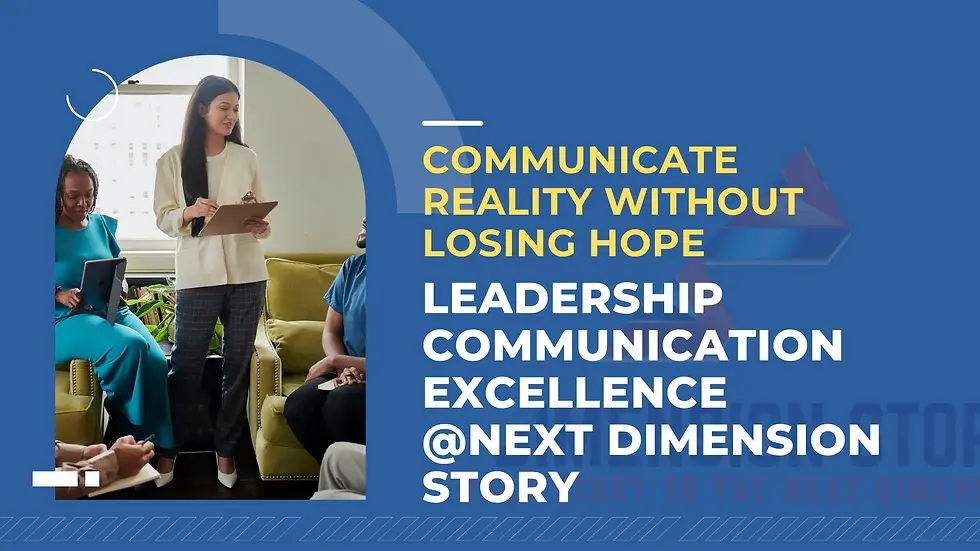
Want to get better at communicating reality whilst keeping hope? Sign up today to one of our guided, practical and powerful communication coaching tools – via the Next Dimension Story Effective Communication Video courses, Audio courses and if you want to quickly master this skill, sign up to a 1 to 1 coaching session with our Expert Communication Coach, George Eapen. With over 25 years of experience, George can help accelerate your leadership communication skills to equip you to become a credible leader who can help his/her team to navigate uncertainty and shape teams to become resilient.
AND NOW AI ENTERS THE CONVERSATION
Technology adds another fascinating layer.
Increasingly sophisticated tools can identify trends, sentiment and even support AI analysis of communication patterns in leaders.
That could help us see things we previously missed.
How often do we interrupt?
How do communication patterns change under pressure?
When do teams disengage?
Where might sentiment be shifting?
Powerful insights.
But data about human behaviour isn't the same as understanding a human being.
AI may identify a pattern.
Leadership still has to decide what that pattern means — and what to do next.
The future leader therefore needs both analytical capability and emotional intelligence.
Not one instead of the other.
TURN INSIGHT INTO BEHAVIOUR
There's a trap hidden inside leadership content.
You read it.
Something resonates.
You think:
That's interesting.
Then another email arrives.
And nothing changes.
My Leadership and Mental Wellness Audio & Video Courses are designed to help turn insights like these into everyday behaviours.
🎧 Use the Audio Courses during walks, journeys and reflection time to keep developing your leadership thinking.
🎥 Use the Video Courses to go deeper into emotional intelligence, leadership behaviour, mental wellbeing, communication and sustainable performance.
Don't try to change ten things.
Choose ONE.
Perhaps listening without interrupting.
Pausing before reacting.
Asking one more question.
Recognising when emotion is influencing judgement.
Then practise it repeatedly.
Because leadership development doesn't happen when you understand a concept.
It happens when pressure arrives — and you behave differently.
WHAT CAN'T YOU SEE?
Some of the hardest leadership patterns to change are the ones we cannot see ourselves repeating.
That's where 1-to-1 Leadership Coaching can become powerful.
Together, we can examine:
What happens to my leadership under pressure?
What triggers me?
Where might bias influence my decisions?
How effective are my communication and interpersonal skills?
What impact is my behaviour having on the people around me?
If you're navigating greater responsibility, organisational change, difficult relationships or sustained leadership pressure,
coaching creates space to examine the leader behind the decisions.
Because sometimes the breakthrough isn't learning something new.
It's finally seeing something that's been there all along.
ONE DOOR REMAINS LOCKED…
Imagine tomorrow you decide:
I'm going to trust my team more.
You remove approvals.
Delegate bigger decisions.
Give people greater autonomy.
Then someone makes a decision you disagree with.
What happens?
Do you step back in?
Add another approval?
Override them?
Take back control?
We've suddenly arrived at the next leadership challenge:
TRUST.
Can you distribute authority without losing accountability?
Can people make mistakes without you immediately reclaiming control?
And perhaps the hardest question:
Do you trust your people — or only when they make the decisions you would have made?
That's where we're heading next.
September: Trust & Distributed Leadership.
Until then, carry one question into your next difficult conversation:
“What might be happening here that logic alone cannot explain?”
Because organisations may operate through systems, structures, data and strategy.
But underneath them are human beings.
Thinking.
Feeling.
Interpreting.
Protecting.
Hoping.
Fearing.
And deciding whether they trust you enough to follow.
Great leadership doesn't choose between rational thinking and emotional intelligence.
It learns when — and how — to use both.


Comments