
How Leadership Thinking Shapes Workplace Culture: Why Organisational Culture Is a Mirror of Leadership
Most organisations think culture is built through values statements.
Mission posters.
Town halls.
Culture workshops.
But here’s the uncomfortable truth:
Organisational culture is rarely written. It is absorbed.
Not from the HR handbook.
From leaders.
Which raises a powerful question:
How does leadership influence organisational culture?
The answer is simpler—and more confronting—than most organisations realise.
Culture is the daily reflection of leadership behaviour and organisational culture signals.
What leaders reward.
What they tolerate.
What they question.
And most importantly—
How leaders think under pressure.
This is the real relationship between leadership and organisational culture.
What Is Organisational Culture in the Workplace?
Before exploring leadership impact, we need to clarify something many organisations misunderstand.
What is organisational culture in the workplace?
Organisational culture is not simply values written on a wall.
It is the collective behaviour patterns employees learn through observation.
Culture emerges from:
• Leadership reactions
• Decision-making patterns
• Communication tone
• Responses to failure and success
Over time, these behaviours become the leadership culture in organisations.
Employees unconsciously learn:
What is safe to say.
What ideas are rewarded.
What mistakes are punished.
And what kind of thinking gets promoted.
This is why leadership behaviour and organisational culture are inseparable.

At Next Dimension Story, we fundamentally believe that your leadership behaviour and your team’s culture and organisational culture are deeply intertwined. How you carry your emotional energy, flex your leadership communication tone, and make note of hidden leadership behavioural patterns that manifest in the way you carry yourself under pressure, can all affect team culture and organisational culture.
Take our Next Dimension Story Effective Leadership Audio or Video courses today – sign up and stay at your own pace to cover the fundamental aspects of effective leadership – Strategy mapping, Micro-decisions, Cultural mapping, Emotional intelligence, Conflict resolution, and Sustainable growth strategies, in an easy-to-follow, highly practical manner. Pick up where you left off and complete the course in a few hours or within a week. Start applying these powerful techniques today and see the difference in weeks, not months.
Our leadership coach, George Eapen, has over 25+ years of international leadership experience within Fortune 500 corporations and small businesses and private companies. George has distilled his years of experience into bite-sized leadership modules across audio and video courses – sign up today and see the difference in two weeks. Let your leadership behaviour positively shape your team and organisational culture!
The Role of Leadership in Organisational Culture
Many companies invest heavily in culture programs.
Yet culture rarely shifts unless leadership thinking shifts first.
Why?
Because the role of leadership in organisational culture is not symbolic.
It is neurological.
Human beings constantly scan for behavioural signals from authority figures.
These signals shape workplace norms faster than policies ever can.
If leaders reward speed over reflection, teams prioritise speed.
If leaders react defensively to criticism, teams avoid challenging ideas.
If leaders demonstrate curiosity and emotional intelligence in leadership conversations, teams begin to think more openly.
That is the leadership impact on company culture in action.
Leadership Psychology in Organisations
To understand how leadership affects organisational culture, we must look beneath behaviour and examine leadership psychology.
Every leader carries a set of internal mental models.
These include:
• Leadership thinking styles
• Emotional triggers
• Risk tolerance
• Beliefs about authority and control
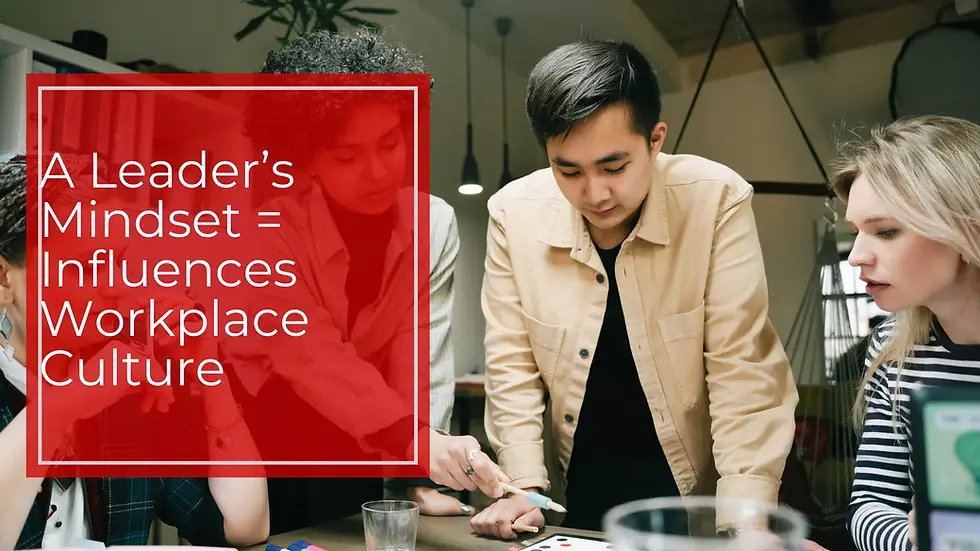
These elements shape a leader’s leadership mindset and influence on workplace culture.
In other words:
Culture is not simply shaped by what leaders say.
It is shaped by how leaders think and respond repeatedly.
This is why modern leadership development increasingly focuses on:
• Emotional intelligence in leadership
• Strategic thinking in leadership
• Leadership psychology in organisations
Because without shifting leadership cognition, culture programs rarely succeed.
Examples of Leadership Shaping Company Culture
Let’s look at a real leadership pattern that appears frequently.
An executive team claims they want a culture of accountability and transparency.
But when difficult news appears in meetings, the CEO’s first reaction is:
“Why wasn’t this handled earlier?”
The intention may be accountability.
But the emotional signal employees receive is different.
They learn:
Bad news leads to scrutiny.
The result?
Information flows slow down.
Problems surface late.
Employee engagement and company culture decline.
This is a classic example of leadership values and company culture misalignment.
Now consider a different leadership response.
When difficult information surfaces, the leader says:
“Thank you for raising this early. Let’s solve it together.”
The cultural signal changes immediately.
Transparency becomes safe.
Ownership increases.
This is one of many examples of leadership shaping company culture.
Leadership Mindset and Organisational Success
Research consistently shows that leadership mindset and organisational success are tightly linked.
Why?
Because leadership thinking shapes how teams make decisions.
A modern leadership mindset encourages:
• Curiosity over certainty
• Collaboration over hierarchy
• Learning over blame

These thinking styles encourage stronger:
• Employee engagement and company culture
• Organisational resilience
• Innovation and problem-solving
These are also the foundations of transformational leadership examples seen in high-performing companies.
Organisations that successfully scale culture change do not simply train employees.
They develop leaders who practice culture-driven leadership strategies.
Leadership Behaviours That Build Strong Culture
If culture reflects leadership psychology, the next question becomes practical.
What leadership behaviours build a strong culture?
Three behaviours consistently shape healthy workplace environments.
1. Curiosity Before Control
Leaders ask questions before issuing directives.
This encourages deeper thinking and improves employee engagement.
2. Emotional Regulation
Leaders demonstrate emotional intelligence in leadership interactions, especially under pressure.
Teams mirror that stability.
3. Strategic Listening
Leaders pause before responding.
This reinforces psychological safety and encourages diverse thinking.
These small signals gradually become leadership behaviours that build a strong culture.
The Next Dimension Story Effective Leadership Workbook covers behavioural recalibration, including strategic listening, emotional regulation, and the need to take the leadership pause before collaborating and directing. The workbook incorporates one leadership behaviour to practice daily, thereby enabling you to see the outcome within a week or two weeks. You can then work on another leadership behaviour and see its positive results within yourself, your team, and your company culture.
We have distilled over 25+ years of leadership experience into bite-sized daily leadership behaviours that you can easily implement and see results in a week or two. That’s the power of developing your leadership skills and seeing a positive transformation in your company culture. Take the opportunity today to purchase the Effective Leadership Micro-Habits Workbook and elevate your leadership impact.
How to Build a Strong Workplace Culture
Organisations often ask:
How do we build a strong workplace culture?
The answer rarely starts with HR initiatives.
It begins with leadership thinking.
An effective organisational culture strategy focuses on:
Leadership mindset development
Awareness of leadership thinking styles
Consistent behavioural modelling
Reinforcement through daily decisions
When leaders change how they think, decide, and respond, teams mirror those patterns.
That is the foundation of successful culture change in organisations.
How Culture Reflects Leadership Values
The most important insight in organisational leadership is this:
Culture is leadership values in motion.
If leaders value learning, curiosity appears in meetings.
If leaders value hierarchy, silence dominates discussions.
If leaders value ownership, employees take initiative.
Culture is not what leaders say they believe.
It is what employees observe leaders doing repeatedly.
This is the deeper relationship between leadership and organisational culture.
Final Reflection
At the beginning of this series, we explored a simple idea.
Leadership transformation does not start with big strategic announcements.
It begins with small, invisible decisions.
The pause before reacting.
The question before judging.
The curiosity before control.
Those moments shape leadership thinking.
Leadership thinking shapes workplace culture.
And workplace culture ultimately determines organisational success.
So, the real question is not:
“How do we change culture?”
It is:
“How must leadership thinking change first?”
Because culture does not start with strategy.
It starts with the leader in the room.


Comments